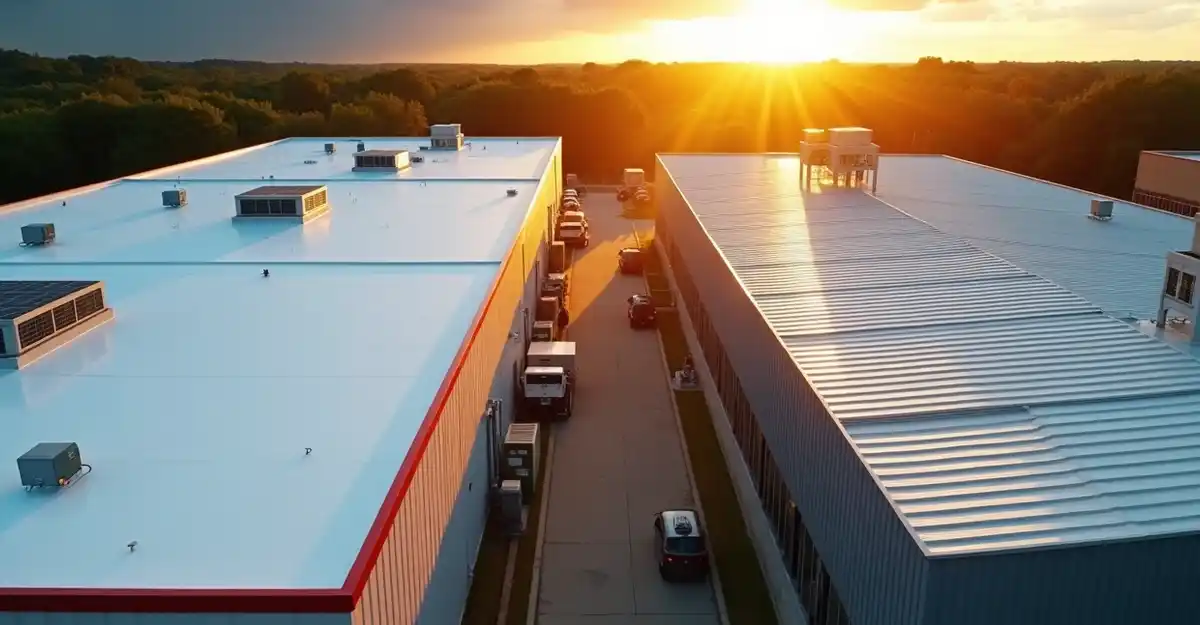
The choice between a TPO and metal roof affects your commercial building’s future for decades. Metal roofs can last 40 to 70 years with proper maintenance. TPO roofing’s lifespan ranges from 15 to 30 years[-3][-5]. This difference in durability often helps property owners make their final decision.
Your commercial roof’s performance goes beyond just how long it lasts. Metal roofs work great in tough weather and can handle heavy rain, snow, and high winds effectively[-3]. TPO roofs shine in energy efficiency because their white or light-colored surfaces reflect sunlight and minimize heat absorption. A metal roof costs about 20-25% more than other options upfront, but it lasts almost three times longer. You could think over a TPO over metal roof installation or TPO overlay to modernize your existing roof. These options typically last 18-24 years. Your building’s ideal metal roofing system depends on your needs, budget, and your property’s long-term plans.
Which Roof Fits Your Building Type?
Your commercial building’s structural design determines which roofing system works best. The roof slope, building function, and environmental factors are vital parts of this decision.
Flat Roofs: TPO’s flexibility and reflectivity
TPO roofing stands out on flat or low-slope commercial structures. This single-ply membrane works perfectly on roofs with slopes less than 3:12. TPO adapts well to a building’s movement and settling and prevents cracks when temperatures change.
TPO’s white surface bounces off most sunlight and heat, so cooling costs drop. This feature helps TPO exceed Energy Star Cool Roofing standards. Businesses in warmer climates find this especially valuable. TPO’s heat-welded seams create a watertight barrier that works great for flat roof applications.
Sloped Roofs: Metal’s structural strength
Metal roofing performs best on commercial buildings with steeper slopes (greater than 3:12). These systems have exceptional strength and work great in areas with heavy snow loads or high winds. Metal roofs shed water, snow, and debris easily because of their slope design.
Building codes specify minimum slope requirements for different metal roof profiles. Steep slopes prevent water from pooling, which often happens with poorly designed flat roofs. Metal roofing also stands up to severe weather and delivers long-term performance for sloped commercial structures.
Industrial Use: Chemical resistance and fire safety
Chemical exposure in industrial buildings makes your roofing choice even more important. PVC works better than TPO near grease traps, vents, and stacks that might release chemicals. Metal roofing offers the best chemical resistance for most industrial applications.
Both systems provide excellent fire protection. TPO has a Class A fire rating and fights flame spread effectively. Metal roofing doesn’t burn and protects against fire without extra treatments. This makes it a great choice for industrial facilities storing valuable inventory.
Your building type and specific needs should guide your choice between these two excellent commercial roofing options.
Performance in Harsh Conditions
Harsh weather puts commercial roofing systems through rigorous testing and reveals the most important performance differences between TPO and metal options.
Extreme Weather: Hail, wind, and snow resistance
Metal roofing provides exceptional protection in severe weather and withstands winds up to 140 mph. These systems earn the highest UL2218 Class 4 Impact rating by resisting 2-inch steel ball impacts dropped from 20 feet. Metal roofs’ superior impact resistance makes them perfect for regions prone to hail.
TPO membranes achieve impressive FM 1-90 and 1-120 wind uplift ratings and withstand pressures of 90-120 psf during cyclonic conditions. The welded seams provide average tensile strengths of 150 lbf/in, which is a big deal as it means that most single-ply systems by 30%.
Thermal Expansion: Flexibility vs rigidity
TPO’s chemical makeup has plasticizers that lower glass transition temperature to -40°F and preserve elasticity in extreme cold. This flexibility allows TPO to maintain over 200% elongation in cold temperatures compared to EPDM’s 120%.
Metal roofing can face thermal movement problems in warm climates that sometimes cause fasteners to loosen over time. TPO’s inherent flexibility helps prevent cracks as temperatures fluctuate.
UV and Heat Resistance: White membrane vs coated metal
TPO maintains temperatures within 10°F of ambient temperature on 100°F days, while black asphalt can reach 160°F. Metal roofing deflects much solar heat through reflective coatings.
TPO uses carbon black and Hindered Amine Light Stabilizers to neutralize free radicals from ultraviolet exposure. Research shows TPO keeps over 90% tensile strength after 10 years in desert environments.
Installation, Upkeep, and Retrofit Options
Your aging roof’s lifespan can be extended through modernization options instead of a complete replacement. Affordable solutions help minimize business disruption.
TPO Overlay: Pros and risks of installing over old metal
TPO overlays cost about half as much as metal-over-metal modernization. A watertight membrane covers your existing metal roof without disruptive tear-offs. Installers place flute fillers in metal panel pans, add insulation to create a flat surface, and heat-weld the TPO membrane. All the same, TPO overlays last only 15-25 years, which is nowhere near the lifespan of metal solutions. A full picture of the existing roof’s structural integrity must happen before installation.
Metal-over-Metal Systems: Strengthening old structures
Metal-over-metal modernization relies on two main methods. The Roof Hugger® system connects to structural purlins and attaches directly over existing panels. Additional insulation and various panel profiles work with this sub-purlin system. The 238T standing seam with high clip systems provides another option that installs directly through existing panels into purlins. Both choices make existing structures stronger while keeping business disruption minimal.
Maintenance Frequency: Seam integrity vs corrosion checks
TPO needs inspections twice a year that focus on seam integrity, tears, and punctures. Quick repairs of any damage stop moisture from getting in. Metal roofing needs yearly inspections to check for loose fasteners, seam separation, and early signs of corrosion. Both systems stay in good shape when debris gets removed regularly to prevent drainage issues.
Best Metal Roofing System: MR-24®, Butlerib II®, VSR II®
MR-24® roof system comes with a 360-degree double-lock Pittsburgh seam that works great for low-slope applications. Butlerib II® saves money with its through-fastened design and superior Scrubolt technology, which doubles the pullout strength compared to self-drilling screws. VSR II® brings architectural beauty with mechanically seamed panels that move up to two inches.
Cost, Efficiency, and Sustainability
Money plays a big role in commercial roofing choices. A deeper look at costs beyond the original price shows key differences between TPO and metal systems.
TPO vs Metal Roof Cost: Initial vs long-term
TPO roofing costs less upfront than metal roofing, which makes it a great choice for budget-focused projects. Large commercial projects find TPO especially attractive because of this price advantage. Metal roofing needs more money upfront (about 20-25% more than other options) but gives you better value over time.
The life expectancy numbers tell the whole story. TPO membranes last 20-30 years, while metal roofing systems can go strong for 40-70 years with good maintenance. This is a big deal as it means that your metal roof investment gives you almost triple the service life for just 25% more upfront cost.
Energy Savings: Reflective surfaces and ASV
Both roof types are great at saving energy by reflecting sunlight. TPO’s white or light-colored surface bounces UV rays away and helps cut cooling costs. Metal roofs also reflect heat really well, especially with reflective coating finishes.
Metal roofs have another trick up their sleeve with Above Sheathing Ventilation (ASV). The air space between the metal roof and base cuts heat transfer by almost 30%. Buildings using ASV keep their attic temperatures just 5 degrees above outside air. Regular roofs let attic temperatures climb almost 40 degrees higher.
Environmental Impact: Recycled content and recyclability
Metal roofs lead the pack in sustainable building materials with an 85% recycling rate. Most metal roofs today use recycled materials. Aluminum roofs have nearly 95% recycled content.
TPO membranes are also eco-friendly. They’re 100% recyclable and don’t contain harmful chemicals like chlorofluorocarbons. These materials stay stable in the environment and can safely go to landfills if needed.
Solar Panel Integration: Mounting without penetrations
Metal roofs work perfectly with solar panels because they last longer than the average solar PV system’s 32.5-year lifespan. You won’t need to take down solar arrays just to replace worn-out roofing materials.
Metal roofs also let you attach solar panels directly to structural ribs or seams without making holes. This simpler mounting system cuts material costs by 42%, labor costs by 30%, and shipping costs by 61% compared to standard mounting systems.
Comparison Table
TPO vs Metal Roofing Comparison Table
| Feature | TPO Roofing | Metal Roofing |
| Lifespan | 15-30 years | 40-70 years |
| Original Cost | Lower upfront cost | 20-25% higher than alternatives |
| Best Slope Application | Flat/low-slope (<3:12) | Steeper slopes (>3:12) |
| Weather Resistance | – FM 1-90 and 1-120 wind ratings – Withstands 90-120 psf in cyclonic conditions | – Withstands winds up to 140 mph – UL2218 Class 4 Impact rating |
| Temperature Performance | – Stays within 10°F of ambient temperature – 200% elongation in cold temps – Flexible in extreme cold (-40°F) | – Thermal movement challenges exist – Fasteners may loosen in warm climates |
| Energy Efficiency | – Excellent UV reflection – White surface reduces cooling costs | – High solar reflectance – 30% heat reduction through ASV |
| Fire Safety | Class A fire rating | Naturally non-combustible |
| Maintenance Requirements | Biannual inspections needed for seam integrity | Annual inspections required for fasteners and corrosion |
| Solar Panel Integration | Not specifically mentioned | – Direct attachment without penetrations – Compatible with solar PV lifespan |
| Environmental Impact | – 100% recyclable – Free from chlorofluorocarbons | – 85% recycling rate – Up to 95% recycled content (aluminum) |
Conclusion
Your choice between TPO and metal roofing comes down to your commercial building’s needs and future plans. Both systems come with their own set of advantages that you should think about before making your decision.
Metal roofing really shines with its exceptional lifespan of 40-70 years, while TPO lasts 15-30 years. This major difference makes up for metal’s 20-25% higher original cost, especially over decades of use. Metal roofs also handle extreme weather better, making them perfect for areas that see high winds, hail, or heavy snow.
TPO brings its own advantages to the table. Your flat or low-slope commercial buildings will get great benefits from TPO’s flexibility and reflective properties. TPO’s lower upfront costs and energy efficiency make it attractive if you need to watch your immediate budget rather than long-term expenses.
The environmental impact might sway your decision too. Metal roofing’s sustainability credentials are impressive with high recycled content that you can recycle almost completely after use. TPO matches this eco-friendliness since it’s 100% recyclable and doesn’t contain harmful chemicals.
Your building’s structure should guide this choice. Steeper slopes work better with metal systems, while flat roofs do great with TPO membranes. Your maintenance team’s capabilities, energy saving goals, and any plans to add solar panels will help shape the best solution for your property.
The right choice between TPO and metal roofing depends on your situation. Each system works best under different conditions and serves different needs. Your commercial building needs roofing that matches its specific requirements to ensure protection, efficiency, and value throughout its service life.
Comments are closed